
What Is a Privacy Coin? How Monero, Zcash and Dash Work

What is a privacy coin? A privacy coin is a cryptocurrency designed to hide who sent a payment, who received it, how much moved, or all three. Monero (XMR) hides all three on every transaction by default. Zcash (ZEC) hides them only when you use its shielded addresses, and Dash offers an optional mixing feature called CoinJoin. Ordinary coins like Bitcoin record those details publicly on the blockchain for anyone to read.
Key takeaways
- Privacy coins use cryptography to hide the sender, the receiver or the amount of a transaction, which public blockchains normally show.
- Monero makes privacy mandatory. Zcash and Dash make it optional, so many of their transactions stay public.
- Several large exchanges have delisted privacy coins, so check where you can buy and sell before you hold one.
Why do privacy coins exist?
Most blockchains are public ledgers. On Bitcoin, every transaction shows the sending address, the receiving address and the amount, and that record is permanent. The Zcash documentation describes its own transparent addresses as working “like Bitcoin”, with those details visible on the blockchain. Anyone who links an address to a person can follow that person’s payments forward and backward.
Privacy coins aim to close that gap. They keep payment details off the public record while the network can still verify that each transaction is valid.

How do privacy coins hide transactions?
Privacy coins combine a few techniques. Each one hides a different part of a payment.
| Technique | What it hides | Used by |
|---|---|---|
| Ring signatures | The sender, by mixing the real input with decoys from the blockchain | Monero |
| Stealth addresses | The receiver, with a one-time address for every payment | Monero |
| RingCT (Ring Confidential Transactions) | The amount | Monero |
| zk-SNARKs (zero-knowledge proofs) | Sender, receiver and amount in shielded transactions | Zcash |
| CoinJoin mixing | The trail between coins, by combining many users’ transactions | Dash (optional) |
Ring signatures
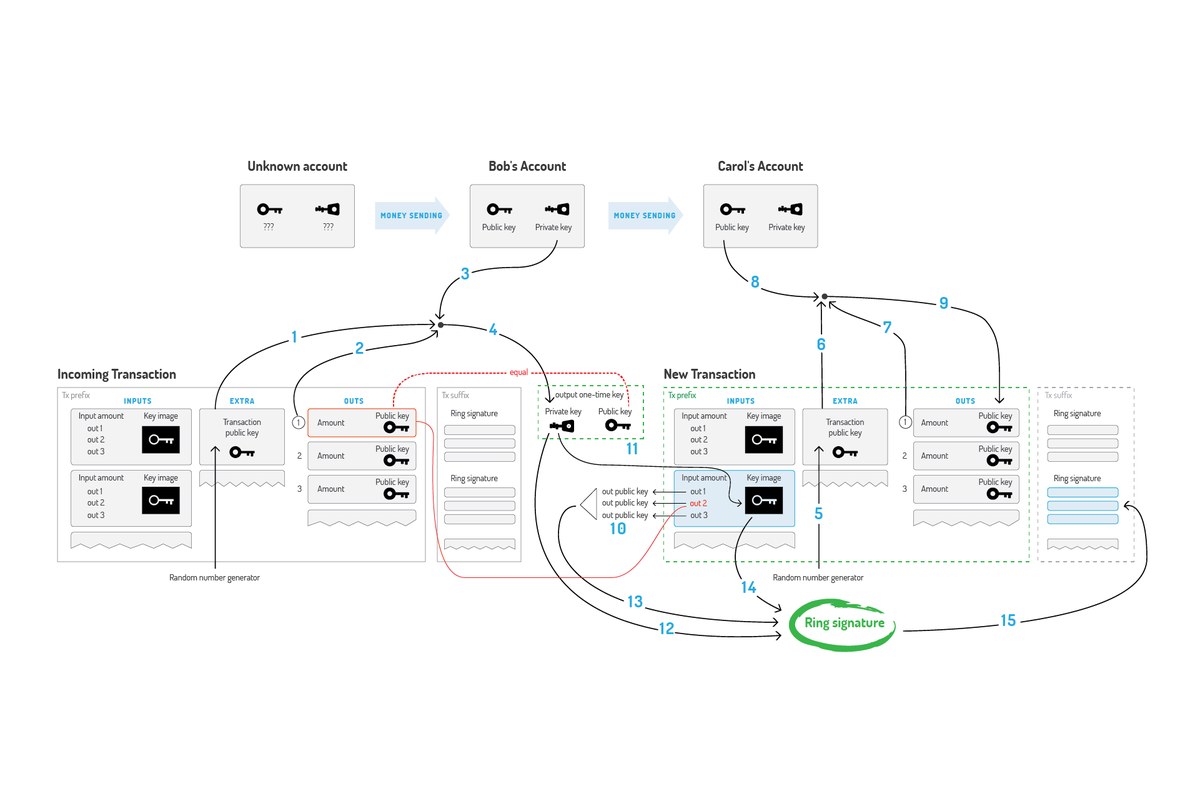
A ring signature signs a transaction on behalf of a group. The Monero Project says there is no way for an outside observer to tell which of the possible signers belongs to your account. The other members of the ring are real outputs taken from the blockchain. Since the network upgrade on August 13, 2022, every Monero ring has 16 members, up from 11.
Stealth addresses
With stealth addresses, the sender creates a random one-time address for every transaction on behalf of the recipient. You can publish one Monero address, and each payment still lands at a separate address that an observer cannot link back to it.
Hidden amounts
Monero hides amounts with RingCT, which became mandatory for every transaction after September 2017.
Zero-knowledge proofs
Zcash describes itself as the first practical use of zk-SNARKs, a type of zero-knowledge proof. A zero-knowledge proof lets the network confirm a transaction is valid without seeing who sent it, who received it or how much moved. Zcash’s Orchard shielded pool, added in the NU5 network upgrade, uses the Halo 2 proving system, which does not need the trusted setup ceremony that its older shielded pools relied on.
What are examples of privacy coins?
| Coin | Privacy | Main technique | Notes |
|---|---|---|---|
| Monero (XMR) | Always on | Ring signatures, stealth addresses, RingCT | Mined on ordinary CPUs with RandomX |
| Zcash (ZEC) | Optional (shielded or transparent) | zk-SNARKs | Fixed supply of 21 million ZEC |
| Dash (DASH) | Optional | CoinJoin mixing | CoinJoin is off by default in the Dash Core wallet |
Dash’s own documentation is candid about the limits: it says CoinJoin makes history harder to trace but is not recommended for users who need a high level of privacy. For a closer look at the two biggest names, read our Zcash vs Monero comparison, or browse our list of the best privacy coins.
Optional vs default privacy: why it matters
When privacy is optional, only the transactions that use it are hidden, and the rest of the chain stays readable. When every transaction uses the same privacy features, as on Monero, there is no public subset to compare against. That is the main design difference between Monero and coins like Zcash and Dash, where the user picks shielded or transparent, mixed or unmixed.
Optional privacy also gives choice. A Zcash user can keep funds on a transparent address that works like a Bitcoin address, and move them to a shielded address when they want privacy.
Are privacy coins legal?
Privacy coins are under growing pressure from regulators and exchanges, and some exchanges have stopped supporting them. The Block reported that Binance delisted Monero on February 20, 2024. Rules differ by country and change often, so check the law where you live before you buy.
How to get started with a privacy coin
- Pick a coin based on the privacy you need: always on (Monero) or optional (Zcash).
- Set up a wallet you control. Our Monero wallet guide covers the official wallet and hardware wallet support.
- Back up your seed offline. Anyone with the seed can spend your coins.
- For Monero, you can also earn coins with a home computer. See how to mine Monero.
FAQ
Is Bitcoin a privacy coin?
No. Bitcoin records the sending address, receiving address and amount of every transaction on a public blockchain. Anyone can read that history, and if an address is linked to a person, their payments can be followed.
Which privacy coin is the most private?
Of the three coins here, Monero is the only one where every transaction hides the sender, receiver and amount by default. Zcash shielded transactions also hide all three, but only when users choose shielded addresses.
Can privacy coins be traced?
They are much harder to trace than public coins, but no system is perfect. The Monero Project notes that a remote node operator can see the IP address a transaction comes from, and that reusing one address or receiving from a service where you hold an account can link payments together.
Why do exchanges delist privacy coins?
Exchanges review the coins they list against their own standards and the rules they operate under, and some have decided privacy coins no longer fit. The Block reported that Binance delisted Monero in February 2024.
Is Zcash private by default?
No. Zcash lets users choose between transparent addresses, which are public like Bitcoin, and shielded addresses, which hide the sender, receiver and amount.
Sources
